
We Need to Talk about Drainage
When Sunset Mesa was built in the early 1960’s, the engineers in charge of the project put in place various drainage systems that are still in use today, over 60 years later.
One of these systems affects approximately 2/3 of our homes. In many cases these drainage systems have been working as intended and homeowners may not even be aware they run under their property. However, with so many homes lost to the fire, and with all the compacting, digging and foundation work, there is now a high likelihood of these pipes getting cut or damaged. This would create a leak under the lower home, and possibly a very expensive problem to fix, especially once a new slab is built on the lot.
The origin of this system lies in the fact that on many streets, the homes on the landward side sit slightly higher than street level and the homes on the seaward side sit below street level grade. This was done to maximize the ocean view of the land side homes, that must look over their neighbors across the street.
What this also means is that water accumulating on the seaward side homes cannot drain onto their streets as the street level is slightly above the home’s base. To solve this problem, the developers put drains, usually in the back yard of the seaward homes (Image 1), connected to an approx. 12” pipe that runs down and under the home below (image 2) and out onto the street below through an exit point (image 3).
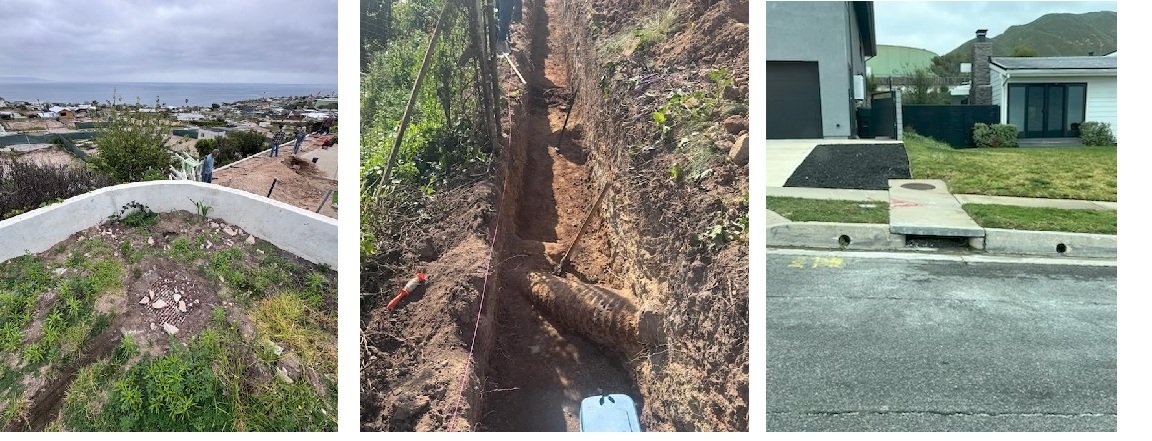
1. Drain on Upper Lot 2. Drainage Pipe on Lower Lot 3. Exit Culvert on Lower Street
In many cases, two or even three upslope homes all drain through one pipe below. Many homes are built on top of these drainage pipes.
Now is the perfect time for homeowners to find out exactly where these pipes run and:
Make sure your contractor is aware of the pipe so they do not accidentally damage it during new construction.
Inspect them to be sure they are in good shape
Repair the pipes if needed
Unfortunately, we do not have an original plan of the location of these pipes. We have asked the county to search but so far, not had any luck. We will continue to search, but with the speed construction is moving at, homeowners should not wait for a map before acting.
Our recommendation is for neighbors to talk and figure out which homes link together in a system and jointly survey, inspect and if necessary, repair any damage.
Where To Start: Act Now and Work Cooperatively
We believe that all these underground drainpipes exit to the lower street through a culvert, shown in image 3 above. If you have one of these in front of your home, it means there is probably a drainage pipe under your property draining one or more houses above you. Our recommendation is to contact your above neighbors to talk and figure out which homes link together in a system and jointly survey, inspect and if necessary, repair any damage.
Finally, the CC&R’s assign each lot owner responsibility for maintaining the drainage facilities on their own lot. Among the provisions on slopes and drainage the CC&Rs state as follows:
“(l) Drainage: The original developers constructed over and under certain lots in the Tracts, conduits, pipes, ditches, catch basins and other drainage devices necessary and required in order to properly drain surface water from all of the herein lots. Said conduits, pipes, ditches, catch basins, drainage devices and 11asements therefore are established so that none of the same shall exist under any residential or any other appurtenant Improvements upon said lands. Said drainage devices are for the mutual benefit and protection for the upper and lower lot owners.
(1) Each and every owner or owners of any lot In said Tracts shall maintain and be responsible for the drainage facilities upon the lot owned by such owner or owners and each such lot owners covenants that he will keep such drainage facilities frea of any debris which may obstruct the clear flow of water through such drainage facilities. Any owner of any lot upon which drainage facilities are located, which such facilities extend t9, under and/or across any adjacent lot, may, in addition to any other remedies he may have, come upon such adjacent lots for the purpose of cleaning or otherwise repairing such drainage facilities In the event that the owner of such adjacent lot falls, refuses or neglects so to do.”
The remit of the SMPOA in regards these drainage systems is only to advise and share all of the information we have available to us, which we are doing. We will continue to push the County for any information they have about the location of these pipes and share anything further that comes to light.
We encourage all affected homeowners to act now and work cooperatively with their neighbors to check their drainage systems, while so many lots are open and exposed and the costs involved are relatively low.
Please let us know any questions you may have.