
SMPOA Board Presentation and Statement- CC&R Town Hall
Statement of the SMPOA Board
This town hall is about the CC&R revote. There will be a short presentation from us and then we will answer any and all questions that are asked, but we request questions please be focused on the topic tonight. If you have questions about other topics, we ask that you please email them to the board or ask them at future town hall.
Who is your Board and what have we been up to:
Nine homeowners
Volunteers
We all lost our homes, or had to move out for a long time because of smoke damage
Most of us have full-time jobs and perform our board work in the evenings and on weekends
What motivates us:
Keeping our neighborhood community INFORMED
Introducing new layers of RESILIENCE to our neighborhood community
Championing the SAFETY and SECURITY of our neighborhood community
Protecting the VALUE of our neighborhood community
What have we accomplished:
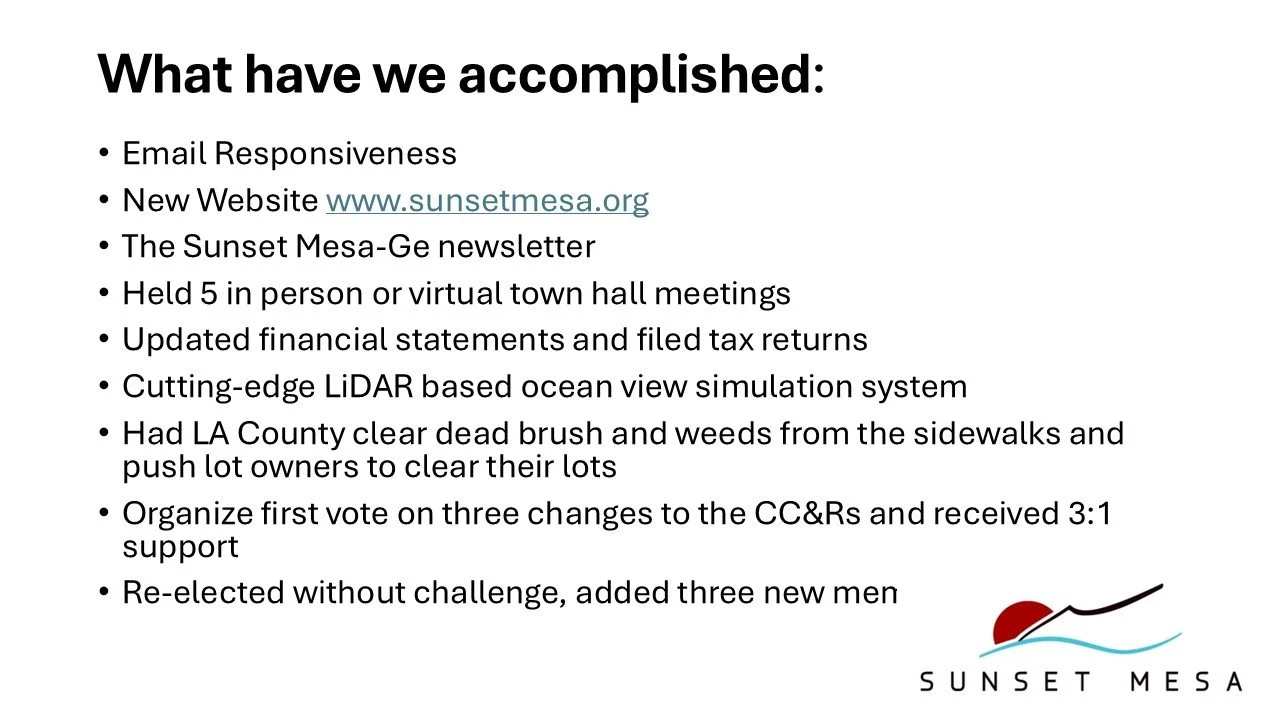
• When we took over it wasn’t just the neighborhood that was in ashes, it was the SMPOA.
• The board’s inbox had hundreds of emails that had not been responded to
• The Website had not been updated for years and 9 months after January 7th, it still made no mention of the fire
• The Sunset Mesa-Ge hadn’t been published in over a year
• The only thing still barely functioning was a reconstituted Architecture Committee.
We believe some homeowners took advantage of the chaos to build during this period without proper ocean view approval, which is a direct attack on our neighborhood community’s shared VALUE, and one of the first things we did was file litigation when it became clear that nothing else would work with them.
In the year since we took over, we have taken steps to Keep You INFORMED, to create infrastructure to enable us to achieve our objectives of RESILIENCE, SAFETY, SECURITY AND VALUE:
• We’ve held 5 in person or virtual town hall meetings where homeowners could hear directly from us and ask questions.
• We have created a new website, complete with information about rebuilding, the status of rebuilding, regular news about the neighborhood and a lot more.
• Published the Sunset Mesa-Ge email newsletter every month, without fail.
• Got our financial statements caught up and filed tax releases that were two years in arrears.
• Developed a cutting-edge LiDAR based ocean view simulation system that removes all of the guess work from rebuild approvals.
• Demanded and got LA County to clear dead brush and weeds from the sidewalks and push lot owners to clear their lots of dangerous fuel.
• Held a vote on three changes to the CC&Rs that received 3:1 support and was approved by the majority of homeowners in Sunset Mesa.
• Responded to dozens of legal threats to the SMPOA and to ourselves individually from homeowners who were unwilling to accept the ruling of the AC that their plans would cause OVI – and we have held fast and not been intimidated.
• Stood for re-election without challenge, added three new members and were re-elected by our members in June.
We continue to work:
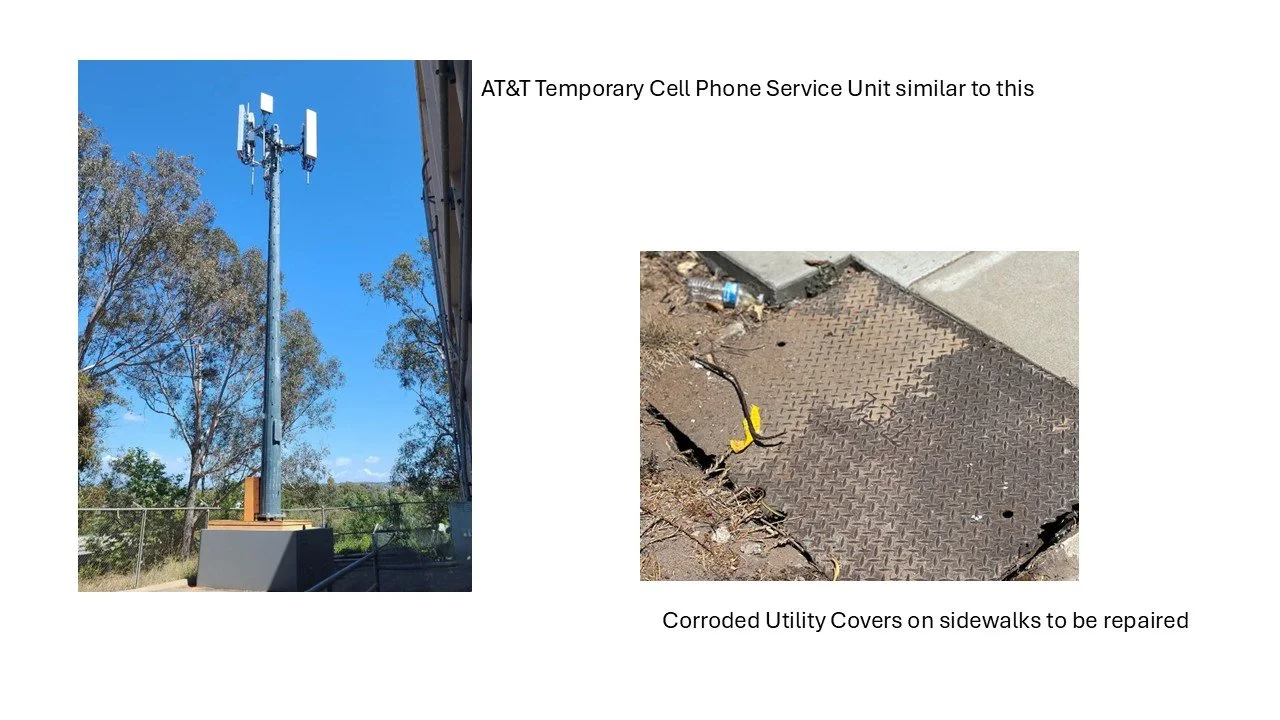
• We have just secured approval from the County and AT&T and will be putting up a temporary cell phone tower to finally provide cell service in Sunset Mesa.
• We are working with the Insurance industry to understand what can and should be done to harden our homes so that they can survive a repeat of the wind driven fire even like we experienced last year and which will allow us to start getting regular and affordable insurance policies and not have to rely on California Fair Plan.
The accusation from certain homeowners that this board is secretive, self-serving and self-dealing is NOT GROUNDED IN FACT , it is deeply insulting to the board and to the community of good people that we represent. These few homeowners who are campaigning against these changes to the CC&Rs are the very ones who took advantage of the chaos after the fire or are trying to do things that the CC&Rs forbid and which the vast majority of homeowners oppose.
The Short Term Rental Prohibition
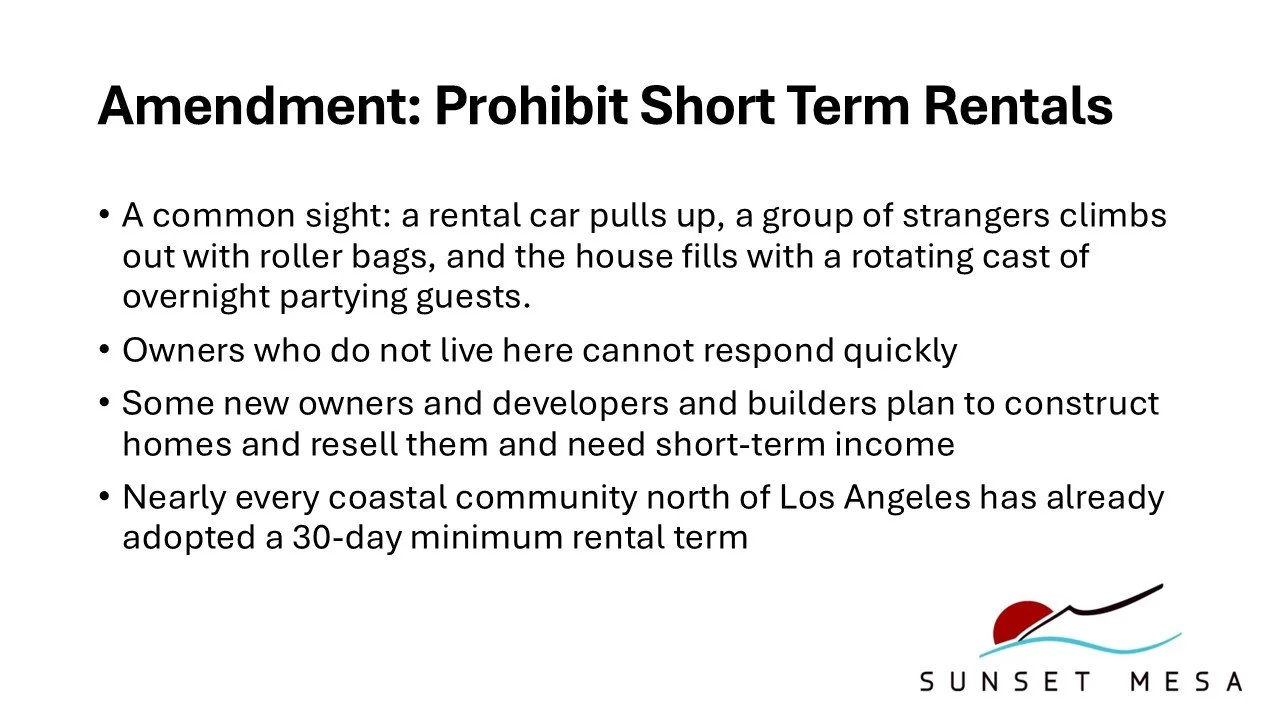
Sunset Mesa has always had renters, and for most of our history they have been a healthy, welcome part of the community. That began to change with the rise of Airbnb and VRBO. More and more, owners started renting their homes for shorter and shorter stretches — a few days, even a single weekend. It became a common sight: a rental car pulls up, a group of strangers climbs out with roller bags, and the house fills with a rotating cast of overnight guests.
Short-term visitors who are only in the neighborhood for a weekend have far less at stake in how they treat it than residents or longer-term tenants do. We are not accusing any current homeowner of permitting late-night parties or reckless driving — and we have no doubt that when problems are reported, most owners take action. But an owner who does not live here cannot respond quickly, and violations are hard to verify after the fact.
The risk is about to get bigger. In just the past few months, a large number of lots — both burned and still standing — have sold to new owners, some of them developers and builders who plan to construct a home and resell it. That business runs on tight margins, and a home sitting unsold generates no income. Once that financial pressure builds, short-term rental income is one of the fastest ways for an investor-owner to offset carrying costs while waiting for the right buyer — which means the incentive to run a full-time Airbnb operation out of a rebuilt home will only grow.
Nearly every coastal community north of Los Angeles has already adopted a 30-day minimum rental term for exactly this reason. If Sunset Mesa does not follow suit, we risk becoming the exception — the neighborhood where a rental car and a bachelor or bachelorette party are one phone call away, every weekend of the year.
This amendment closes that door. It requires any lease to run at least 30 days, in writing, and in compliance with our governing documents — protecting the quiet, residential character that makes Sunset Mesa worth living in.
The Roof Deck Amendment
For as long as anyone can remember, SMPOA boards have interpreted our CC&Rs to prohibit roof decks. That interpretation has been challenged in court before — and it has never lost. This amendment does not change that rule. It writes it down in plain, explicit language so it can never again be seriously challenged.
Goal: Preserving views, privacy, and tranquility.
Sunset Mesa was built as a tiered, stadium-style neighborhood specifically so that homes set back from the ocean could still see over the rooftops in front of them. That design only works if roofs stay roofs. This amendment adds express language to the CC&Rs so there is no ambiguity left to argue about.
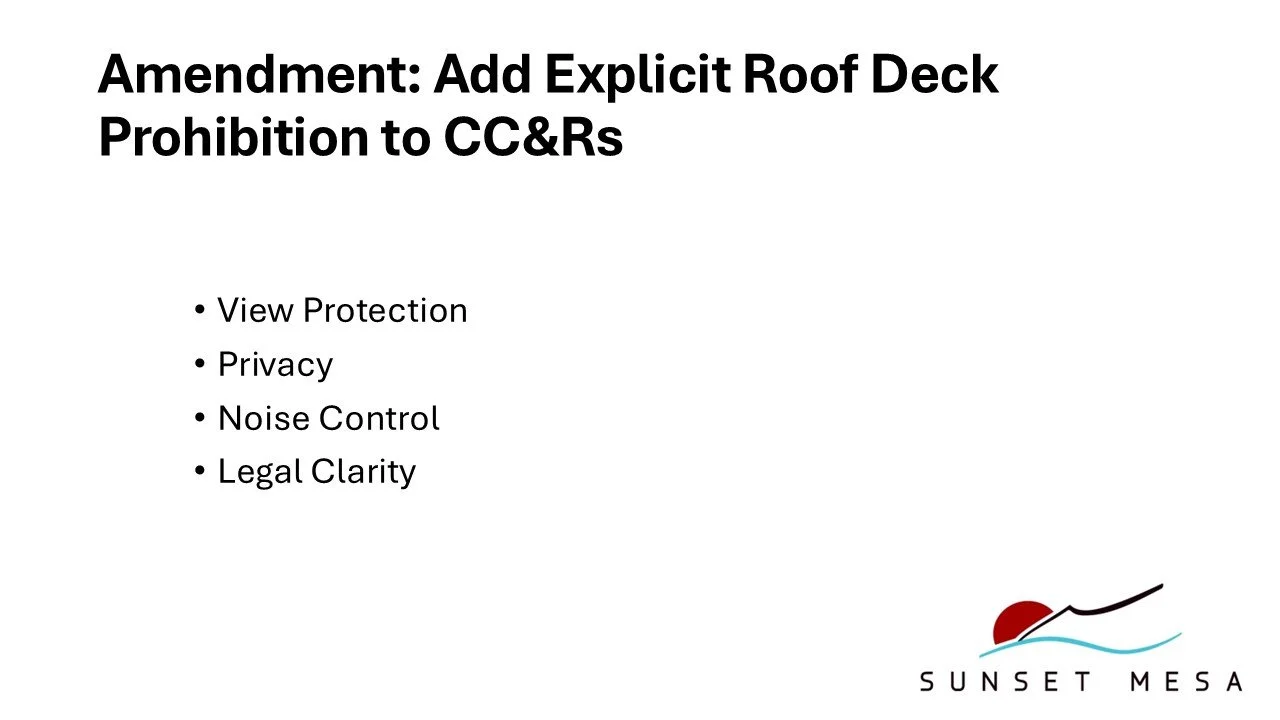
View Protection: A bare deck might seem harmless, but once it is filled with furniture, plants, and umbrellas, it becomes a real, permanent visual barrier for the neighbors behind it — defeating the entire premise of Sunset Mesa’s tiered layout.
Privacy: Because of that same tiered topography, roof decks would look directly into the bedrooms and private outdoor spaces of the homes above and below it.
Noise Control: Sound from an elevated deck travels much farther than noise at ground level, and can disturb an entire block, not just next-door neighbors.
Legal Clarity: Explicit language removes the incentive for a developer or new owner to test our rules in court, sparing the Association the time and expense of defending a policy we have always enforced.
We are not asking anyone to give up something they already had. A small number of homes had roof decks before the fire — most built decades ago, with no surviving record of how they were approved. The Board and the Architecture Committee agree that those homeowners should be able to rebuild what they had. So if an owner can show their home had a roof deck before the fire, and there is no record of the AC ever denying it, the AC will approve a rebuilt deck in the exact same size, height, and position as before. Everyone else builds under the same rule that has always applied.
The AC has already reviewed dozens of rebuild plans that initially included a roof deck. In nearly every case, once the prohibition was explained, the owner respectfully removed it — because homeowners here understand and respect this rule. We do not want to keep fighting this same battle plan by plan, or risk having to defend it in court again. Passing this amendment turns a policy we have always enforced into an explicit rule no one can credibly dispute — protecting the views, privacy, and quiet that define Sunset Mesa.
The Loser Pays Legal Fees Amendment
No one wants to end up in a lawsuit with a neighbor or the Association. But when litigation is the only way to protect an ocean view or a home’s value, our current rules make that choice needlessly expensive — even when you are right.
Here is the problem: under our CC&Rs today, if a neighbor blocks your view with a fence, a wall, an overgrown tree, or new construction, you have every right to ask them to fix it. But if they refuse to engage or refuse to remove it, your only real option is to sue — and even if you win, you are still stuck covering your own attorneys’ fees. That financial risk is enough to stop many homeowners from ever standing up for their rights, which means views get blocked and home values suffer, simply because fighting back costs too much.
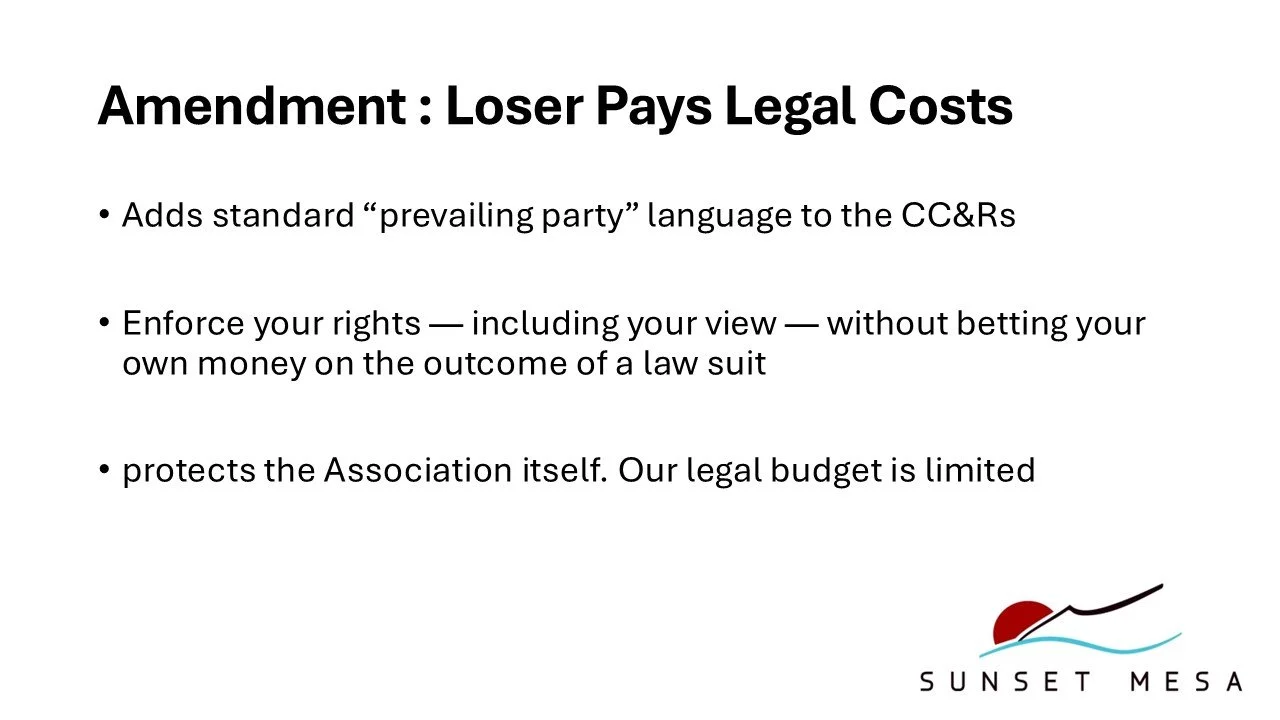
This amendment fixes that. It adds standard “prevailing party” language to the CC&Rs: in any lawsuit or dispute between the Association and a member, or between two members, whoever wins is entitled to recover their attorneys’ fees and costs from whoever loses. This is not a novel or aggressive change — these provisions are standard in CC&R documents across California, and most neighborhoods already have them in place.
The benefit runs both ways. For homeowners, it means you can enforce your rights — including your view — without betting your own money on the outcome of a lawsuit. For the community as a whole, it works as a deterrent: a homeowner who knows they will be on the hook for both sides’ legal bills if they lose is far less likely to violate a neighbor’s rights or block a view in the first place. Fewer violations mean fewer lawsuits.
It also protects the Association itself. Our legal budget is limited, and the SMPOA can only take on a small number of enforcement matters each year, which means individual homeowners are often left to defend their own rights on their own dime. This amendment levels that playing field, making it realistic for homeowners to enforce the CC&Rs without the Association’s help — and making violations less likely to happen in the first place. That is a direct investment in protecting property values and the character of Sunset Mesa for everyone.
Why are we Revoting
Sunset Mesa's CC&Rs are the contract every one of us signed when we bought our home here. They haven't been meaningfully updated in decades, and they were never written with anything like our situation in mind: the near-total rebuilding of an entire community after a wildfire. Past boards recognized they were out of date and tried to modernize them, but a full rewrite proved too big a job to finish. Your current board made a deliberate choice instead: rather than attempt everything at once, we identified the three changes homeowners need most and put our full effort behind getting them right. All three passed by a decisive 3-to-1 margin in May.
Tracts are mentioned throughout the CC&Rs. They define the boundaries of the SMPOA community and set different minimum setbacks from property to property. Tracts also sit at the center of a critical ambiguity in our governing documents: the rule for how the CC&Rs themselves get amended.
Here is the exact language currently in our CC&Rs:
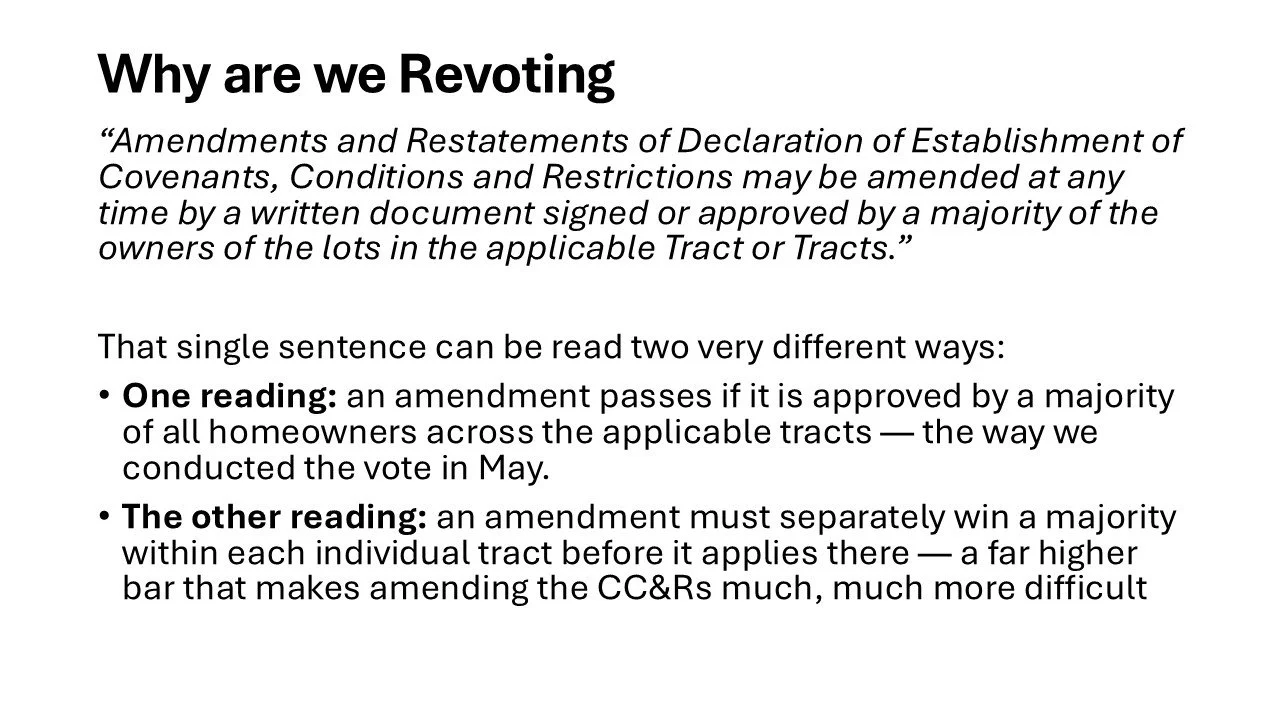
“Amendments and Restatements of Declaration of Establishment of Covenants, Conditions and Restrictions may be amended at any time by a written document signed or approved by a majority of the owners of the lots in the applicable Tract or Tracts.”
That single sentence can be read two very different ways:
One reading: an amendment passes if it is approved by a majority of all homeowners across the applicable tracts — the way we conducted the vote in May.
The other reading: an amendment must separately win a majority within each individual tract before it applies there — a far higher bar that makes amending the CC&Rs much, much more difficult, tract by tract, forever.
We used the first reading in May, and all three amendments passed 3-to-1. But afterward, opponents of these changes signaled they would challenge that interpretation in court. Had they followed through, Sunset Mesa would have faced a long, expensive legal fight — with a judge, not homeowners, deciding what our own governing document means. Worse, none of the amendments the majority voted for could be enforced until that fight was resolved.
We are not willing to let a legal technicality override the clear will of three-quarters of Sunset Mesa. So your board chose the more conservative path: we are re-running the vote under the tougher standard — the second reading above — so no one can credibly argue the result is invalid. At the same time, this amendment locks that standard in as the permanent, unambiguous rule going forward, so Sunset Mesa never has to relitigate this question again.
That is why you are seeing this vote a second time. If you voted in May, thank you — please vote again. If you did not, now is the time to read the amendments, understand what is at stake, and make your voice count.
To find out what tract your home is in, please log in to your PayHOA account and on your Dashboard, click on the “custom fields” or you may email us at SMPOABoar@gmail.com