
Rebuild Progress, Learning and Momentum
Over the past several months, there has been tremendous progress toward rebuilding Sunset Mesa. To date, 116 rebuild plans have been approved by the Architectural Committee out of 300 we expect to process. Already, some construction has started and the AC’s energy and focus toward granting approvals remains strong.
Over the past several months, there has been tremendous progress toward rebuilding Sunset Mesa. To date, 116 rebuild plans have been approved by the Architectural Committee out of 300 we expect to process. Already, some construction has started and the AC’s energy and focus toward granting approvals remains strong.
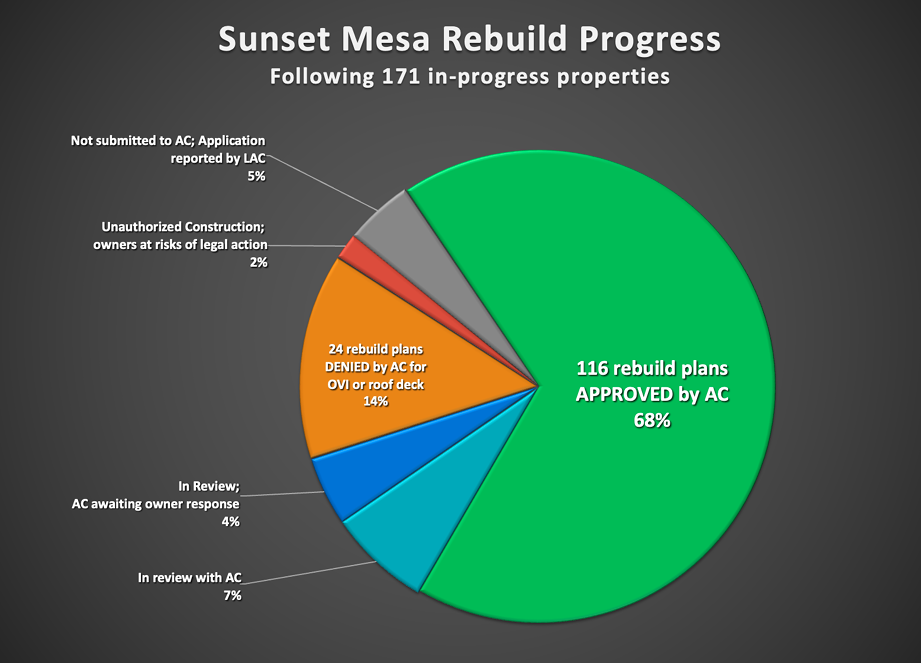
Number of Re-Build Plans in each Architectural Committee Status
We are continuously seeking feedback to improve the rebuild process, specifically regarding guidance and tips for expeditious plan approval by the Architectural Committee (AC). Our goal is to adapt our community’s rebuilding efforts to ensure all property owners are treated fairly and efficiently while maintaining a smooth, successful recovery.
The SMPOA maintains a Frequently Asked Questions page that addresses most common inquiries. Please check the FAQ first; you may also email the AC or schedule a meeting. We strongly recommend consulting the AC early to avoid surprises. Ensure your plans include elevation drawings with an overlay of the previous structure’s outline. If you lack these specifications, the AC usually has them and will share them upon request.
Working in Good Faith It is encouraging to see so many homeowners collaborating constructively with the AC to restore their properties in alignment with our CC&Rs. We aim to recover with a spirit of compassion and respect that honors the legacy of Sunset Mesa. Everyone suffered in the wake of the Palisades Fire, and every resident is entitled to fairness, decency, and the harmony our neighborhood enjoyed before the tragedy on January 7, 2025.
Currently, the vast majority of submitted plans have been approved. When plans are denied, the reason is almost always Ocean View Interference (OVI). Building higher than the previous structure at any point in the roofline will likely cause approval problems. If a design would not have been approved before the fire due to OVI, it will not be approved now. Our focus is on restoring each property’s original qualities, not creating new view corridors at a neighbor’s expense.
Group Builds - What To Know
Owners opting to participate in a group build follow the same AC plan review guidelines and process as any other property, so there are no extra steps or process changes to worry about.
Guidance for upcoming group builds, based on learnings from 2025:
Certain design strategies can significantly reduce redesign cycles, delays, and overall costs
Selecting a model that closely matches the original height and roof profile for the lot
Avoiding full roof flattening where the original roof was pitched
Maintaining previous massing toward the ocean-facing side
Maintaining previous massing toward the ocean-facing side
Communicating early with immediate neighbors
Not every model or roof configuration is appropriate for every lot
Ocean View Interference (OVI) is a critical constraint that must be evaluated early, especially when selecting models or modifying rooflines
Changes from the previously-standing home , like going from pitched to flat roofs, increasing massing, or shifting volumes can trigger OVI even if they seem minor on paper